





| Quick Definition: SWOT Analysis is a strategic management tool used to audit and evaluate an organization’s overall strategic position. It analyzes internal Strengths and Weaknesses alongside external Opportunities and Threats to align organizational resources with the operating environment. |
1. What is a SWOT Analysis?
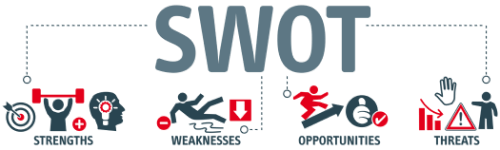
SWOT is an acronym for Strengths, Weaknesses, Opportunities and Threats.
By definition, Strengths (S) and Weaknesses (W) are considered to be internal factors over which you have some measure of control.
Also, by definition, Opportunities (O) and Threats (T) are considered to be external factors over which you have essentially no control.
SWOT Analysis is the most renowned tool for audit and analysis of the overall strategic position of the business and its environment.
Its key purpose is to identify the strategies that will create a firm specific business model that will best align an organization’s resources and capabilities to the requirements of the environment in which the firm operates.
In other words, it is the foundation for evaluating the internal potential and limitations and the probable/likely opportunities and threats from the external environment. It views all positive and negative factors inside and outside the firm that affect the success.
A consistent study of the environment in which the firm operates helps in forecasting/predicting the changing trends and also helps in including them in the decision-making process of the organization.
An overview of the four factors (Strengths, Weaknesses, Opportunities and Threats) is given below-
| HELPFUL (To achieving organizational goals) |
HARMFUL (To achieving organizational goals) |
|
|---|---|---|
| INTERNAL (Direct Control) |
STRENGTHS (S) • Core competencies & expertise • Tangible & intangible assets • Strong financial reserves & low debt • Customer goodwill & brand loyalty |
WEAKNESSES (W) • Depreciating/obsolete machinery • High staff turnover • Narrow product lines • Insufficient R&D facilities |
| EXTERNAL (No Control) |
OPPORTUNITIES (O) • Emerging market trends & demand • Market deregulation • New demographics & segments • Technological advancements |
THREATS (T) • Increasing industry competition • Rapid tech shifts & price wars • Supply chain/raw material costs • Restrictive government laws |
2. The Four Pillars Breakdown
Strengths (Internal & Helpful)
Strengths are the internal qualities and capabilities that enable an organization to accomplish its mission and build sustained success.
- Key Drivers/Attributes: Tangible assets (financial capital, machinery) and intangible assets (expertise, team traits, distinct brand features).
- Examples: Huge financial resources, broad product lines, low or no debt, committed employee workforce, strong customer goodwill.
Weaknesses (Internal & Harmful)
Weaknesses are internal factors that prevent an organization from reaching its full potential, deteriorate growth, and fail to meet operational standards. Because they are controllable, they must be minimized or eliminated.
- Key Drivers/Attributes: Internal operational operational flaws, resource shortages, and procedural bottlenecks.
- Examples: Obsolete or depreciating machinery, insufficient R&D facilities, narrow product ranges, poor decision-making processes, high debt, excessive raw material waste, and high employee turnover.
Opportunities (External & Helpful)
Opportunities arise from the external environment when conditions allow an organization to execute strategies that increase profitability and competitive advantage.
- Key Drivers/Attributes: Market trends, industry deregulation, technological shifts, and new demographic segments.
- Examples: Rapidly increasing demand for telecommunications combined with market deregulation opening doors for new entrants.
Threats (External & Uncontrollable)
Threats occur when external environmental conditions jeopardize the stability, reliability, and profitability of the business. They compound organizational vulnerability when linked directly to internal weaknesses.
- Key Drivers/Attributes: External market disruptions, competitive moves, and regulatory hurdles.
- Examples: Employee unrest, rapidly changing technology rendering products obsolete, aggressive competitor price wars, and excess market capacity.
3. Applications and Uses of SWOT Analysis
SWOT’s universal value lies in its versatility across organizational scales and planning horizons:
- Organizational Level: Evaluates overall market position before launching major operations, expanding into new niches, or executing corporate restructuring.
- Product Lines and Projects: Scrutinizes specific investment prospects or individual product lines to isolate what’s lagging and where growth exists.
- Across Sectors: Applied extensively in business as well as non-profits, government agencies, and local community initiatives for fundraising and master planning.
- Individual and Team Assessments: Serves as a personal framework for performance improvement, career development, and mapping personal growth goals.
- Strategic Initiatives: Prepares leaders for major milestones like brand overhauls, geographic expansions, acquisitions, or merger integrations.
In essence, anytime clarity and informed decision-making are required–be it big-picture strategy or a single department’s goals–a SWOT analysis delivers structured insight.
4. How to Conduct a SWOT Analysis: Key Steps & Brainstorming Questions
To get the best out of SWOT Analysis, corporations need a practical approach that includes a consistent framework, alignment of resources, and precision in strategic planning.
To begin with, lay out or specify clear goals. Be clear with the purpose of conducting SWOT Analysis. For instance, do you want to review a new product launch, or do you want to expand your niche, or do you need to analyse your complete strategy? This will be a good guide and make your discussion more fruitful.
- Gather Relevant Data and Perspectives: Collect information from various sources, both internal and external. Engage team members across functions–such as sales, operations, and finance–to ensure a holistic view. Leverage data on resources, market trends, regulatory changes, and customer feedback.
- Brainstorm and List Factors: Encourage open discussion and idea generation for each SWOT category. Use brainstorming sessions or collaborative tools like whiteboards or sticky notes to capture all potential strengths, weaknesses, opportunities, and threats. There are no wrong answers at this stage–diverse viewpoints can spark valuable insights.
Sample Questions to Guide Brainstorming:
-
Strengths
- What do we do best? What unique resources do we have?
- What are we doing well?
- What’s our strongest asset?
- What is our competitive advantage?
- What resources do we have?
- What products are performing well?
-
Weaknesses
- What are our detractors?
- Where can we improve?
- What products are underperforming?
- Where are we lacking resources?
- What are our lowest-performing product lines?
-
Opportunities
- What trends are evident in the marketplace?
- What demographics aren’t we targeting?
- What new technology can we use?
- Can we expand our operations?
- What new segments can we test?
-
Threats
- How many competitors exist, and what’s their market share?
- Are there new regulations that could potentially harm our operations or products?
- What regulations are changing?
- What are competitors doing?
- How are consumer trends changing?
-
- Refine and Prioritize: Review all inputs, then distill them into the most impactful points. Debate as needed to identify which factors warrant the most attention and align with your strategic objectives.
- Establish Effective Strategies: Use your developed SWOT conclusions to create precise action plans. For example, you might decide to develop a core competency, solve a catastrophic situation, or grab a bright opportunity with a smart initiative.
By implementing the above-mentioned things, organizations ensure that SWOT Analysis is used for long-term success and informed decision-making.
5. Converting Analysis into Strategy (The TOWS Matrix)
Identifying factors is only the first step. To execute effectively, pair internal factors with external factors:
- Strengths–Opportunities (SO): Deploy core strengths to aggressively capitalize on external opportunities.
- Weaknesses–Opportunities (WO): Overcome internal weaknesses by taking advantage of emerging market opportunities.
- Strengths–Threats (ST): Leverage internal strengths to buffer against or mitigate external threats.
- Weaknesses–Threats (WT): Establish defensive strategies to minimize internal vulnerabilities and avoid external threats.
6. Advantages vs. Limitations
| Advantages of SWOT Analysis | Limitations of SWOT Analysis |
|---|---|
| Foundation for Strategic Planning: Serves as a primary source of information for setting objectives. | Subjectivity & Simplification: Can cause organizations to oversimplify complex situations due to personal bias. |
| Identifies Core Competencies: Helps synchronize resources and capabilities with the competitive environment. | No Execution Methodology: Tells you what factors exist, but does not prescribe how to identify or prioritize them. |
| Informs Future Forecasting: Uses past and current metrics to help chalk out future scenarios. | Uncontrollable Variables: Cannot resolve macro threats like raw material inflation, import restrictions, or sudden legislation. |
7. Common Mistakes to Avoid
- Data Over Intuition: Avoid filling the matrix with executive opinions. Backup every listed factor with concrete market research, financial statements, or customer data.
- Failing to Keep It Short: Limit items to 3–4 critical bullet points per quadrant to prevent strategic focus from getting diluted.
- Not Aligning Strengths with Market Priorities: An internal feature is only a true strength if target customers value it and it leads to a strategic gain.
- Hesitating to List Weaknesses: Employees often hesitate to report internal faults. Use anonymous channels or open dialogue to capture honest appraisals.
- Lack of Departmental Diversity: Include stakeholders from sales, finance, operations, and support to build a well-rounded analysis.
8. Frequently Asked Questions (FAQ)
Q: What is the primary purpose of a SWOT Analysis?
The primary purpose is to evaluate an organization’s current strategic position and synchronize its internal capabilities with external market conditions.
Q: What is the main difference between SWOT and TOWS?
SWOT focuses on identifying and categorizing internal and external factors, whereas TOWS matches those factors into actionable strategy pairs (SO, WO, ST, WT).
Q: Are internal weaknesses controllable?
Yes. Unlike external threats, internal weaknesses (such as obsolete machinery or poor quality control) are within management’s direct operational control to fix or eliminate.
Feel like you fall short of the basics of SWOT Analysis and how it can transform your business decision-making? Our course on SWOT Analysis looks at it from every angle. So, lock into one of the powerful tools in strategic management.
Through straightforward, practical instruction, you’ll learn how to thoroughly analyse organisational strengths, weaknesses, opportunities, and threats to make better business decisions. This course shows you how to swerve common SWOT analysis pitfalls, put your head to effective brainstorming contributions, and use your analysis in actionable plans.
You might already be leading a business and looking to sharpen your strategic thinking, a consultant aiming to deliver more value to clients, or a student preparing for a management career. Wherever you are, you are guaranteed to draw value from this course which provides the structured framework and practical tools you need to conduct professional-grade SWOT analyses that drive real success. Don’t just learn about SWOT Analysis – master it with our expert-led, practical approach that has already helped over 9,700 professionals step up in their strategic planning capabilities.