





Accounting is often called “the language of business”. Just as people use a language to share ideas, businesses use accounting to share information about their money: what they earned, what they spent, what they own and what they owe.
A simple definition is this: accounting is the process of recording, summarizing, reporting and analyzing a business’s financial transactions so that people can make better decisions.
Every organization needs accounting, from a corner shop to a government department. Without it, owners would not know whether they are making a profit, banks would not know whether to lend, and tax authorities would not know what is due.
This article explains what accounting means, how it developed over thousands of years, what it aims to achieve, who uses it, and its main branches.
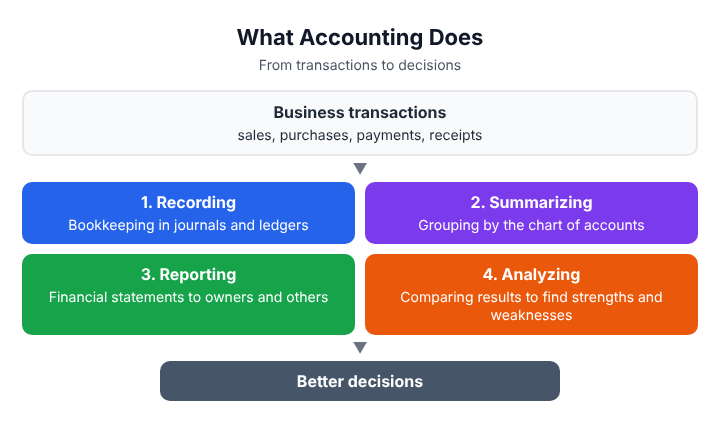
The Four Functions of Accounting
-
Recording
The first job of accounting is to record every transaction the business makes. Deciding what counts as a transaction and writing it down is called bookkeeping.
Bookkeeping is narrower than accounting. It covers only the recording part. Accountants keep a set of books, such as the journal and the ledger, and follow systematic procedures. Today, most recording is done automatically by accounting software as sales and payments happen.
-
Summarizing
Recording creates a mass of raw data. Pages of individual entries are of little use to a manager. So accountants group transactions into categories, defined in a list called the chart of accounts.
When a transaction happens, two things occur. The individual record is made, and the summary total is updated. For example, a sale of $100 to Mr. X is recorded in his account, and total sales rise from, say, $500 to $600.
-
Reporting
Managers are answerable to the owners and investors whose money they use. They must update them regularly, mainly through financial statements: the balance sheet, the income statement and the cash flow statement.
Listed companies in the US and India report every quarter. In many other countries, including the UK and most of the EU, the legal minimum is half-yearly. The EU dropped its quarterly reporting requirement in 2013 to discourage short-term thinking, although some companies still publish quarterly updates voluntarily. All listed companies publish an annual report. These reports are regulated so that they do not mislead readers.
-
Analyzing
Finally, the results are analyzed. Managers compare profits, sales, costs, cash and assets with past periods, budgets and competitors. This shows what is going well and what needs fixing.
A Short History of Accounting
Accounting is as old as trade itself. Once people began to lend and borrow, they needed records.
- Ancient Mesopotamia (from about 3000 BC): Clay tablets record stocks of grain, livestock and debts. This was single-entry record keeping, which is intuitive but incomplete.
- Bahi-Khata in India: Indian merchants developed a sophisticated bookkeeping tradition called Bahi-Khata, kept in red cloth-bound ledgers. It is still used by some traditional businesses. Some writers suggest it influenced later systems, but there is no firm evidence either way.
- Italian merchants (13th to 15th centuries): Traders in Florence, Genoa and Venice used double-entry bookkeeping to manage growing businesses. In 1494, the Franciscan friar and mathematician Luca Pacioli published the first printed description of the system in a section called Particularis de Computis et Scripturis (Details of Accounting and Recording) in his book Summa de Arithmetica, Geometria, Proportioni et Proportionalita. He did not invent it, but his book spread it across Europe, and he is often called the “father of accounting”.
- Chartered companies (17th and 18th centuries): Governments granted companies such as the East India Company exclusive trading rights. Ordinary citizens invested in them, so managers had to report results to outside shareholders. Accounting now served external investors as well as internal managers.
- Industrial era (19th and early 20th centuries): Railways and factories needed cost accounting and depreciation. Professional bodies, such as the Institute of Chartered Accountants in England and Wales (1880), were formed.
- Modern accounting: After the 1929 crash, the US created the SEC (1934) and formal standards followed. Today most countries use IFRS or national standards based on it, while the US uses US GAAP. Software and cloud systems now record transactions in real time.
Objectives of Accounting
Every business activity needs a purpose, and accounting has several.
- Keep a permanent record. Every commitment of money, inside or outside the firm, is recorded and kept for years. Records are needed for management, tax, audits and legal disputes.
- Measure results. A firm makes profits on some transactions and losses on others. Accounting adds them up for each period to show the overall result.
- Show the financial position. The balance sheet shows what the business owns and owes at a point in time.
- Prove creditworthiness. Banks and investors ask for past accounts before they lend or invest. A good track record makes funding easier and cheaper.
- Use resources efficiently. Records show which activities used which resources and what they returned. Managers can learn from the past and improve.
- Support projections. Past data helps forecast future sales and costs. Analysts assume the business will behave somewhat as it has before, adjusted for known changes.
- Meet legal requirements. Company and tax laws require proper books and published accounts.
Who Uses Accounting Information?
| User | What They Want to Know |
|---|---|
| Owners and shareholders | Is the business profitable? Is my investment growing? |
| Managers | Which products, branches or costs need attention? |
| Lenders and banks | Can the business repay loans and interest? |
| Suppliers | Will we be paid on time? |
| Employees and unions | Is the business stable? Can it afford pay rises? |
| Government and tax authorities | How much tax is due? Are laws being followed? |
| Investors and analysts | What is the company worth? Should I buy or sell? |
Main Branches of Accounting
| Branch | Focus | Main Users |
|---|---|---|
| Financial accounting | Recording transactions and preparing financial statements | Investors, lenders, regulators |
| Management accounting | Budgets, forecasts and reports for decisions | Internal managers |
| Cost accounting | Cost of products, services and processes | Production and pricing managers |
| Tax accounting | Calculating and filing taxes | Tax authorities, the business |
| Auditing | Independent check of the accounts | Shareholders, regulators |
| Forensic accounting | Investigating fraud and disputes | Courts, investigators |
Bookkeeping vs. Accounting
People often use the two words to mean the same thing, but they differ.
- Bookkeeping is the routine recording of transactions. It is mostly clerical and increasingly automated.
- Accounting includes bookkeeping but goes further. It summarizes, reports, interprets and advises. It needs judgment, for example about how to value stock or when to recognize revenue.
Practical Guide: The Accounting Cycle, from Transaction to Financial Statements
The four functions of accounting come together in the accounting cycle, the steps a business repeats every month or year. The first four steps are mainly bookkeeping. The later steps call for the judgment that makes it accounting.
- Collect the source documents: Invoices, receipts, bank statements and payroll records show what happened.
- Record transactions in the journal: Each transaction is entered in date order, with its debit and credit.
- Post to the ledger: Entries are moved to individual accounts, such as cash, sales and amounts owed to suppliers.
- Prepare a trial balance: Total debits and total credits across all accounts are compared to check that they match.
- Make adjusting entries: Following the accrual and matching principles, the accountant records income earned but not yet billed, expenses incurred but not yet paid, depreciation, and payments received in advance.
- Prepare an adjusted trial balance: The balances are checked again after the adjustments.
- Prepare the financial statements: The income statement shows performance, the balance sheet shows the financial position, and the cash flow statement shows where cash came from and went.
- Close the books: Income and expense accounts are transferred to retained earnings (or capital) and reset to zero, ready for the next period.
Conclusion
Accounting turns thousands of individual transactions into clear information that people can act on. It began with clay tablets, was refined by Italian merchants and has grown into a regulated, global profession. Its objectives remain the same as ever: keep honest records, measure results and help people make sound decisions with money.
Frequently Asked Questions
What is accounting in simple words?
Accounting is the process of recording, summarizing, reporting and analyzing a business’s money transactions so that owners, managers and others can make good decisions.
Who is the father of accounting?
Luca Pacioli is usually given that title. He published the first printed description of double-entry bookkeeping in 1494, although merchants were already using it before then.
Why is accounting called the language of business?
Because it is the common way businesses communicate their financial performance and position. Investors, lenders and managers all “read” accounts to understand a business.
What is the difference between financial and management accounting?
Financial accounting produces standardized reports for outsiders, such as investors and regulators. Management accounting produces detailed, flexible reports for managers inside the business.