





Recognizing the need to invest in youth entrepreneurship, governments and international agencies have adopted long-term agendas. They work together on strategies and plans to build training programs, raise awareness among young people and their families, and give young people the skills and knowledge to choose entrepreneurship as a career.
People often say leadership is inborn and cannot be learned, but that is not always true. When it comes to young people and entrepreneurship, a sustained effort to build entrepreneurial and leadership qualities clearly helps and produces results.
Youth entrepreneurship is a blend of attitude, character, behavior, passion and a natural inclination toward enterprise and leadership, sharpened through training, awareness and the skills needed to become an entrepreneur. A good leader is not automatically a good entrepreneur, and a good entrepreneur need not be a polished leader. It takes more than either quality alone.
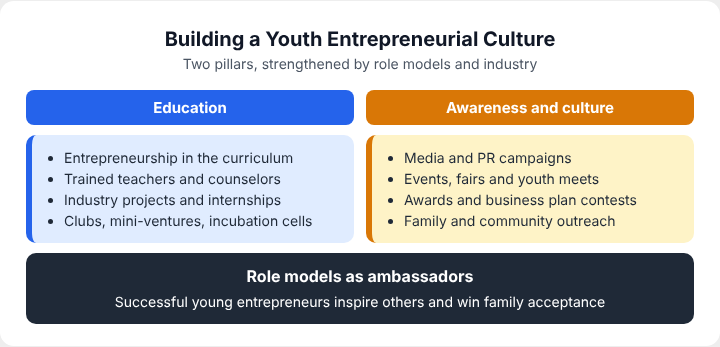
Creating an entrepreneurial culture among young people calls for a two-pronged strategy: entrepreneurship education, and awareness and culture-building through media, PR and role models. This article covers both.
Building Youth Entrepreneurship Through Education
Start Early
Entrepreneurship as an attitude can be nurtured in the early, formative years. Making entrepreneurship development part of the high school curriculum, and extending it into college and university, gives budding entrepreneurs momentum and helps them shape their ideas and dreams.
Sustained education and awareness programs, combined with training in business skills, build a culture that promotes enterprise.
What Entrepreneurship Education Involves
The first and most important platform for building awareness and introducing young people to entrepreneurship is entrepreneurship education. This means including entrepreneurship and management studies at all levels of education. The action plan includes:
- Developing course content and syllabi and making them available to teachers.
- Training teachers and counselors to become entrepreneurship educators.
- Providing the infrastructure and facilities needed.
- Involving industry and business organizations in programs at the college level.
The last point is one of the most important. Industry involvement gives young people hands-on experience and a better understanding of the business and economic environment.
A Benchmark: Quebec’s Youth Entrepreneurship Challenge
The Canadian province of Quebec’s Youth Entrepreneurship Challenge, a multi-year action plan launched in the mid-2000s, is often cited as a benchmark for building youth entrepreneurship through education.
Under the plan:
- The program worked extensively with primary, secondary and university education, and with student and teacher communities, to make entrepreneurship education part of the curriculum.
- Educators and counselors received extensive training to include entrepreneurship in their teaching.
- Awareness campaigns and training reached families and communities, and entrepreneurial initiatives were promoted on industry and official platforms, creating wide public interest in youth entrepreneurship.
- Beyond awareness, the program set up initiatives to support young entrepreneurs and incubate their projects, introduced mentoring and business management training, and supported micro-credit projects run by young entrepreneurs, one of its most effective actions.
The Global Picture
Many countries, including the US, Canada and Australia, offer entrepreneurship and business courses in schools and universities, along with specialized higher education programs. These help create well-informed, well-trained entrepreneurs who can launch new ventures and grow them into organizations that create jobs.
Globally, however, many education systems are still not equipped to make entrepreneurship education a regular part of the syllabus. The reasons vary:
- Lack of interest from students and parents
- Lack of suitable teaching material and infrastructure
- Lack of qualified teachers
In higher education, the picture is better. Universities increasingly work with industry, and companies support students and participate in their projects and studies.
| Traditional Education | Entrepreneurial Education |
|---|---|
| Prepares students to find jobs | Prepares students to create jobs as well |
| Focus on theory and exams | Focus on projects, problem-solving and practice |
| Failure is penalized | Failure is treated as learning |
| Little contact with industry | Regular industry involvement and mentoring |
| Teacher-led | Student-led, with teachers as facilitators |
Promoting a Youth Entrepreneurship Culture Through Media and PR
Apart from introducing entrepreneurship education, the strategy must build entrepreneurial awareness and culture among young people. Media and communication can create an entrepreneurial spirit among the young.
Effective ways to build the culture include:
- Awareness programs, orientation camps, group discussions and targeted campaigns
- Promoting youth entrepreneurship events on every possible platform
- Young achiever awards and competitions
- Youth meets, seminars, conferences, festivals and fairs
- Print and digital media: brochures, banners, magazine features and social media
- Interviews with successful entrepreneurs and young founders in the media
Such PR activities build awareness and enthusiasm among young people. They also change how families, society and individuals see entrepreneurship.
There are also business simulation games and competitions that invite young people to create business plans. These are most relevant for those who are already interested in starting an enterprise and are pursuing business education.
Role Models: The Best Youth Entrepreneurship Ambassadors
A significant part of learning happens through role models. Almost every young person grows up with one or more role models they try to emulate.
Many values, thinking patterns and attitudes are absorbed from a role model’s personality and character. That is why engaging successful young and adult entrepreneurs as youth entrepreneurship ambassadors is one of the best strategies for motivating young people.
When a young entrepreneur wins an award, his or her success story becomes widely known. Seeing someone start a business and succeed makes other aspirants more confident about trying it themselves.
Success encourages people to take risks. It also helps families and society accept the idea of young people starting their own ventures, which is often the biggest hurdle in cultures that value stable jobs.
| Culture-Building Tool | What It Achieves |
|---|---|
| Entrepreneurship education | Builds knowledge, skills and the right attitude early |
| Industry involvement | Gives hands-on experience and real-world exposure |
| Media and PR campaigns | Spreads awareness and changes perceptions |
| Awards and competitions | Celebrates success and creates visible role models |
| Entrepreneur ambassadors | Inspires and guides young people directly |
| Family and community outreach | Wins acceptance for entrepreneurship as a career |
Practical Ideas for Schools and Colleges
Schools and colleges do not need large budgets to start building an entrepreneurial culture. A few practical steps go a long way:
- Entrepreneurship clubs: Student-run clubs where members brainstorm ideas, run small projects and invite local business owners to speak.
- Mini-ventures: Short projects in which student teams run a small stall, an online store or a service for a term, keeping simple accounts.
- Business plan competitions: Contests judged by local entrepreneurs, with mentoring for the best teams.
- Internships and shadowing: Time spent with start-ups and small businesses to see how they really work.
- Alumni founders: Former students who started businesses returning to share their journeys, mistakes included.
- Incubation cells: In colleges, a small space and mentor network where students can develop serious ideas.
How to Run a Campus Micro-Business Challenge
A term-long business challenge is one of the cheapest ways to turn the mini-venture idea into a regular campus event. Teachers or the entrepreneurship club can run it in four steps:
- Form mixed teams: Put students into teams of three or four, mixing technical, creative and commercial skills so each team can design, make and sell.
- Give a small starting budget: Give each team a modest amount to buy materials or tools, to be returned from their earnings at the end.
- Open a trading window: Allow teams a few weeks (one month works well) to sell a product, run a stall or offer a service on campus or online, keeping track of what they earn and spend.
- Hold a review session: Ask each team to show simple profit-and-loss accounts and present what sold, what customers said and what went wrong. Treat the mistakes as the most valuable part of the learning.
Bringing It All Together
Engaging industry and successful entrepreneurs, through talks to young people, youth entrepreneurship promotion, and interaction with students in schools, colleges and other platforms, can collectively build an environment that supports growth through youth entrepreneurship.
A nation’s competitiveness does not start on the factory floor or in the engineering lab. It starts in the classroom, and in the attitudes young people form there about creating something of their own.
Frequently Asked Questions
How can a youth entrepreneurial culture be built?
Through a two-pronged strategy: entrepreneurship education at all levels, and awareness-building through media, PR, events, awards and successful role models.
Why is entrepreneurship education important?
It develops entrepreneurial attitudes early, teaches business skills, gives hands-on industry exposure, and helps young people see entrepreneurship as a real career option.
Why are role models important for young entrepreneurs?
Young people learn a great deal by emulating others. Seeing peers succeed builds their confidence and helps families and society accept entrepreneurship as a career.
Can entrepreneurship be taught?
Natural inclination helps, but entrepreneurial attitudes, skills and knowledge can be developed significantly through education, training, mentoring and practical experience.