





Every business, large or small, faces threats it cannot fully predict. A fire, a cyberattack, a flood, a power failure or a terrorist incident can bring operations to a halt.
The question is not whether a disruption will happen, but how quickly and effectively the business can recover when it does. This is where disaster recovery (DR) and business continuity planning (BCP) come in.
The two terms are often used interchangeably, but they are not the same. DR focuses on recovering specific IT systems, data and assets. BCP focuses on keeping the business running, even at reduced capacity, while recovery happens.
A good combined DR/BC plan covers all technology assets, including hardware, software, data, servers and voice and data communications. It also covers every critical business process that depends on them.
Insurance, Disaster Recovery and Business Continuity Compared
Businesses first managed disaster risk through insurance, which covers the loss of assets from natural and human-made calamities. Insurance and DR/BC look at similar risks, but they respond in very different ways.
| Approach | Main focus | What it delivers | Limitation |
|---|---|---|---|
| Insurance | Physical and financial assets | Compensation after a loss | Pays for the damage but does not keep customers served |
| Disaster recovery (DR) | IT systems, data and technical assets | Restoration of infrastructure as fast as possible | May restore systems while operations remain halted |
| Business continuity (BC) | Critical processes, people and facilities | Minimum viable operations during and after the disruption | Needs ongoing investment, testing and ownership |
| Combined DR/BC plan | Technology recovery plus operational continuity | Lowest total financial, operational and reputational impact | Requires company-wide commitment |
In short, insurance makes good the loss, while DR/BC tries to prevent the loss from happening, or at least keep it small. Organizations that depend heavily on IT now treat DR/BC as a must-have management practice alongside insurance.
Why Every Business Needs a DR/BC Plan
DR/BC planning was once seen as the concern of nuclear power plants, data centers and large banks. Today it is a baseline expectation for any organization that relies on technology, which means virtually every business.
Customers Demand It
Customer and market expectations have risen sharply. Companies are expected to deliver on their promises regardless of natural calamities, political turmoil or terrorism.
For high-value products, especially those that support critical functions at the customer’s end, customers expect suppliers to demonstrate a working DR plan. In banking, IT services, healthcare and telecommunications, suppliers are often required to commit to a DR plan as part of the supplier contract. Without one, you can lose the deal.
When severe floods hit Thailand in 2011, automotive and hard-disk plants were shut for weeks and global supply chains felt the impact for months. Companies with multiple-site redundancy recovered far faster than those relying on a single plant.
Brand and Market Share Are at Stake
Customer loyalty is fragile. A single prolonged outage of an e-commerce platform, a banking system or a supply chain can permanently damage a brand, because customers have many alternatives.
Global companies with operations in several regions have a natural DR advantage: they can shift production or services elsewhere. Businesses with a single point of failure have no such option.
Stakeholders and Regulators Require It
Boards and shareholders expect companies to perform under all circumstances. Regulators in banking, healthcare and data-sensitive industries increasingly mandate DR/BC plans, and lenders and insurers may demand them as a condition of financing or cover.
The 9/11 attacks in 2001 were a watershed. Companies with alternate sites and tested plans resumed critical operations within hours to days. Those without them took weeks, and some never recovered.
What Risks Does a DR Plan Cover?
Risk assessment and DR planning involve the entire organization at every level. At the highest level, a DR/BC plan protects four things:
- Business processes, so that supplies to customers and markets continue
- The lives and safety of employees
- Management control, so that decisions can still be made and communicated
- Assets, so that equipment, data and records can be recovered
Natural Disasters: Predictable and Unpredictable
Some threats come from geography, weather and other natural forces over which we have little or no control. These fall into two groups:
- Predictable risks, such as seasonal monsoons or cyclones, give some warning and allow preparation.
- Unpredictable risks, such as sudden floods, earthquakes and fires, can disrupt the business without giving anyone a chance to prepare.
Human-Made Disasters
These include sabotage, terrorism, industrial espionage, vandalism and cyberattacks. Many companies also treat these as disaster risks:
- Supply failures, such as a supply chain breakdown or a key supplier going under
- Scarce raw materials, especially where the company depends on a few suppliers for materials that are not freely available
- Loss of skilled manpower, which in technology and service companies can make the entire business process unstable
National and International Events
Wars, international sanctions, unstable political situations and strikes can disrupt operations and supplies. The severity of the threat depends on the country and the business.
Technology and Critical Hardware Failures
Companies that depend on high-end technology run the risk of hardware or software failure bringing the entire business process to a halt. In manufacturing, the failure of a critical machine can stop supplies just as effectively.
The table below groups these risks into seven categories that a business impact analysis should examine.
| Risk category | Examples |
|---|---|
| General/physical | Fire, floods, earthquakes, storms, building damage, power failure, security breaches |
| Political/local | Civil unrest, strikes, wars, sanctions, government policy changes, local economic instability |
| Financial/legal | Stock market disruptions, bank failures, contract litigation, customer or supplier disputes |
| Human resources | Occupational hazards, employee safety incidents, loss of skilled staff, key person dependency |
| Technical/production | Critical machinery failure, damage to proprietary processes, infrastructure breakdown, R&D loss |
| IT/data | Hardware failure, software crashes, data loss, hacking, ransomware, network outages, backup failures |
| Market/supply/reputational | Supplier failure, scarce raw materials, PR crisis, brand damage, social media incidents |
An analysis can go down to a very fine level and produce a huge list of risks. It is impossible to build a recovery plan around all of them, so management must make a judicious call about which risks the plan must cover and focus resources there first.
Business Impact Analysis, RTO and RPO
The business impact analysis (BIA) is the foundation of the plan. It identifies every credible risk to each critical process, measures its impact and makes the potential business loss identifiable and quantifiable.
The BIA does not stop at listing losses. It sets limits on how much disruption the business can sustain. Those limits are expressed as two key targets.
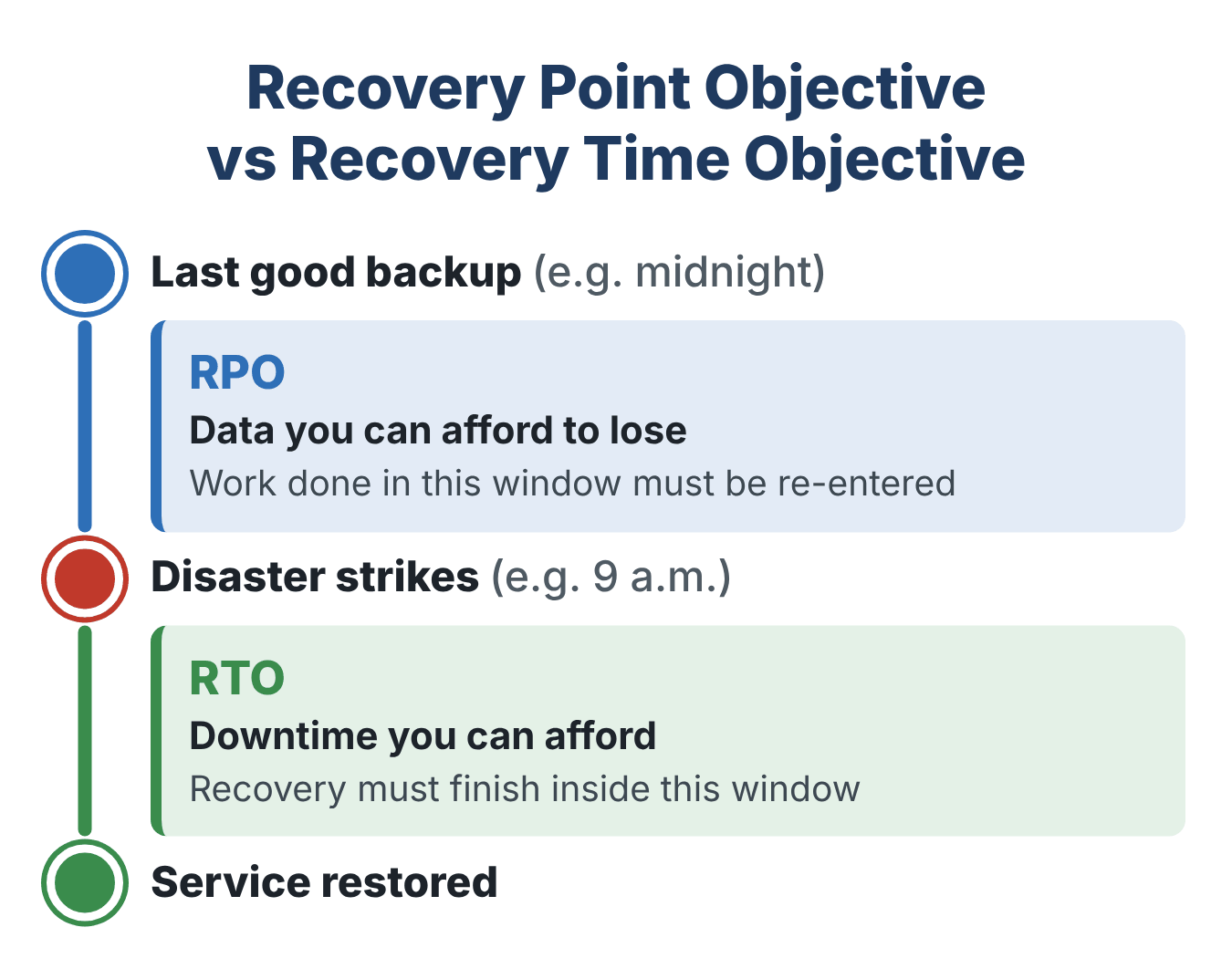
Recovery Time Objective (RTO)
For each failure or disruption, the team first calculates the lead time needed to get the system or process running again. It then discusses how long the organization can actually withstand the disruption before losses become unacceptable.
That maximum tolerable downtime is the recovery time objective. It becomes the primary target that the DR plan must meet. Some businesses can survive a day of disruption; others, such as payment processors, can tolerate only a few minutes.
Recovery Point Objective (RPO)
Every recovery starts from a fixed point in time, the last good copy of the data. Suppose a company backs up its financial systems every night at midnight, and a disaster strikes at 9 a.m. the next morning. Data can only be restored to the state it was in at midnight, so nine hours of transactions must be recreated.
The recovery point objective is the maximum amount of data, measured in time, that the business can afford to lose. When RPOs are set for every critical process, it becomes clear which systems need a closer recovery point, and the backup frequency can be increased accordingly.
A Worked Example
An online retailer sets an RTO of two hours and an RPO of 15 minutes for its order system, and an RTO of three days and an RPO of 24 hours for its HR system. The order system therefore needs continuous data replication and a hot standby site. For HR, nightly backups and a cold site are enough.
Two related terms are also worth knowing:
- Maximum tolerable downtime (MTD): the absolute limit beyond which the damage becomes irreversible. The RTO must always be shorter than the MTD.
- Work recovery time (WRT): the time needed after systems are back to verify data and catch up on missed work.
How to Guide: Classifying Applications into RTO/RPO Recovery Tiers
Balancing recovery speed with infrastructure expenditure requires matching system criticality to appropriate technical configurations:
| Tier & Objective | Target Metrics | Applicable Workloads | Recommended DR Architecture |
|---|---|---|---|
| Tier 0 (Mission Critical) | RTO ≈ 0 RPO ≈ 0 |
Core payment gateways, online transaction ledgers, emergency dispatch | Active-active multi-region cloud clustering or continuous mirror hot site |
| Tier 1 (Business Critical) | RTO ≤ 4 hours RPO ≤ 1 hour |
Customer portals, ERP transactional modules, inventory tracking | Warm standby site or automated Cloud Disaster Recovery as a Service (DRaaS) |
| Tier 2 (Non-Critical) | RTO ≤ 24–48 hours RPO ≤ 24 hours |
Internal HR systems, billing archives, reporting databases | Cold site or daily automated off-site cloud backups with manual spin-up |
DR/BC Sites and Recovery Options
The backbone of any DR/BC plan is the alternate site that takes over when the primary site is disrupted. The right choice depends on process criticality, the RTO and the budget.
Types of DR/BC Sites
- Hot site: A fully equipped, “plug and play” facility with systems pre-loaded and data mirrored, able to operate within minutes to an hour or so. It is the most expensive option but essential where even a short outage is catastrophic, as in banks, payment processors and airlines.
- Warm site: Hardware and connectivity are in place, but recent data and some software must be loaded. Recovery typically takes hours to a day or two.
- Cold site: A shell with power, connectivity and security but no installed equipment. Recovery usually takes several days or longer. It is much cheaper but slow.
- Mobile or portable site: Workspace in trailers or prefab cabins that can be moved to where it is needed during a localized disaster.
- Cloud disaster recovery (DRaaS): Systems are replicated to a cloud provider and started on demand. It is increasingly popular because it offers near-hot recovery on a pay-as-you-use basis.
- Internal branch or overseas facility: Multinationals often use existing branches or sister facilities instead of a dedicated third-party site.
- Employee homes or business centers: These suit minimal, low-criticality continuity, not full system recovery.
Additional Recovery Assistance Options
- Vendor performance guarantees: Hardware vendors commit to zero or pre-specified downtime, with critical spares held on-site.
- Hardware insurance: Vendors commit to replacing failed hardware within a stipulated time.
- Third-party commercial DR services: Specialists provide managed DR sites and recovery services, which is often more cost-effective for large, complex IT environments.
A simple rule of thumb for data is the 3-2-1 backup rule: keep three copies of your data, on two different types of media, with one copy off-site.
How to Build Your DR/BC Plan
A DR/BC plan is neither a one-person job nor a one-time exercise. It needs input from across the organization.
- Get management commitment. Senior management must decide to invest, define the tolerance for downtime and give the plan credibility and budget.
- Conduct the BIA. For each process, map dependencies (systems, people, suppliers, facilities), estimate how long it can be down, assess the financial, operational and reputational impact, and list the internal, external, natural and human-made threats.
- Prioritize. Set a clear recovery order. Revenue-generating, customer-facing and regulatory-critical processes usually come first.
- Design the recovery solution. Choose the site type, backup systems, data recovery approach, staffing, communication protocols and vendor arrangements for each priority area.
- Document, test and maintain. Run mock drills, testing the most critical processes most often, and update the plan whenever processes, systems or risks change.
What a Good DR/BC Plan Document Must Contain
The plan should be clear enough for any team member to act on it in a crisis without calling the author. It must include:
- Objective, scope and last review date
- Sponsoring authority and responsible team
- Crisis declaration criteria, and who has the authority to activate the plan
- Command structure and escalation path
- Step-by-step recovery processes for each function, in priority order
- An emergency contact directory with SLA commitments
- DR/BC site details: location, access, resources and activation steps
- Document control: version history and distribution list
- A mock drill schedule, with a way to record outcomes and lessons learned
A DR/BC plan is only as good as its last test. If it has not been drilled recently, assume it will not work.
Why DR/BC Plans Fail
Many organizations create a plan and then let it gather dust. This is almost always a management failure rather than a technical one. The three most common causes are:
- Management loses interest. Plans are often triggered by a scare, such as a near miss, a competitor’s outage or an audit. When the threat fades, so does attention.
- Budgets are cut. DR sites, drills and mirrored systems cost money and become easy targets in cost-cutting cycles.
- No ownership, no drills. Without a named owner and regular tests, people discover an outdated plan in the middle of a crisis.
What Good DR/BC Governance Looks Like
- A named DR/BC owner with board-level accountability
- A protected budget
- Drills at least annually for all functions, and more often for critical ones
- Plan updates triggered by any significant change in systems, processes or locations
- DR/BC readiness as a standing item on the senior management agenda
The cost of maintaining a DR/BC plan is predictable and manageable. The cost of not having one when disaster strikes is not.
Frequently Asked Questions
What is the difference between a disaster recovery plan and a business continuity plan?
A DR plan focuses on recovering IT systems, data and technical infrastructure. A BC plan covers how the whole business keeps operating, including people, processes and facilities. Most organizations combine both into a single DR/BC framework.
What is the difference between RTO and RPO?
RTO is how long a system can be down before recovery must be complete. RPO is how much data, measured in time, the business can afford to lose. RTO looks forward from the disaster; RPO looks back to the last backup.
What risks does a disaster recovery plan cover?
It covers threats to business processes, employee safety, management control and assets. These arise from natural disasters, human-made events, political and international events, and technology failures.
What is a hot site vs a cold site?
A hot site is fully equipped and mirrored, ready within minutes to an hour. A cold site provides space and utilities only, and needs several days or more to set up. Warm sites fall in between.
Does a small business need a DR/BC plan?
Yes, arguably more than large firms, because small businesses have less redundancy. Even a simple backup strategy and an emergency contact list can mean the difference between recovery and closure.
How often should DR/BC plans be tested?
At least annually, and more often for critical systems. Many organizations run quarterly tabletop exercises and an annual full drill, each followed by a lessons-learned report.
Who should be involved in building a DR/BC plan?
Senior management sets priorities and budgets. IT defines technical recovery. Each department maps its own processes. HR handles people risks and emergency communication, and legal and compliance make sure regulatory requirements are met.