





Culture shapes how people think, feel and act — and it varies not just from country to country, but across industries and individual organizations too. For a global business, it’s worth thinking about culture as operating at four distinct but interconnected levels.
The Four Levels of Culture
- National Culture: the shared values, beliefs and customs of a country’s people that shape their behavior. Scandinavian countries, for instance, place an unusually high value on individual liberty — reflected in historical resistance to national identity cards, which are widely accepted in many other countries.
- Business Culture: the shared values and customs that guide how business is conducted within a given country, which can affect everything from customer expectations to business ethics. Some countries explicitly favour personal and family connections in business dealings, an approach that would be viewed as improper in others.
- Industry Culture: the shared norms that shape how organizations within a specific industry operate, regardless of national culture. Academic institutions worldwide, for example, tend to share a belief in academic freedom, even as the details vary by country.
- Organizational Culture: the shared values and customs that shape how people within a single organization actually behave — shaped by all three levels above it, plus factors specific to that organization, like its size and its management style. This is especially complex for a global organization, which has to navigate multiple national and business cultures at once.
These four levels constantly interact with and influence one another. An organization’s own culture, for instance, is shaped by the national culture it operates in, the business culture of that country, the culture of its industry, and its own specific circumstances.
Culture and Consumer Behavior
Culture has a major impact on consumer behavior — spending patterns, what customers prioritize when buying, and how they respond to a given type of advertising all vary meaningfully across regions. A global business needs to give real thought to culture when designing, marketing and promoting any product.
Culture and Management
Management in a global business inevitably has to navigate cultural differences — in how much importance is placed on punctuality, how formalised workplace relationships need to be, and how much weight is given to seniority versus experience. Culture also shapes employee attitudes toward work, motivation, loyalty to the company, individual initiative, and group accountability. Success in Western organizations is often attributed to individual enterprise and innovation, while success in many Asian business contexts is more commonly linked to a strong work ethic and organizational loyalty.
Cultural diversity within a global organization can be a genuine source of conflict if handled poorly — but managed well, it becomes a real asset, feeding the kind of innovative thinking businesses need to sustain a competitive advantage in a fast-changing environment. Because culture resists being fully and precisely defined, understanding and managing these differences remains a genuine, ongoing challenge for management — not a one-time problem that can simply be resolved and archived.
The EPRG Matrix: Classifying an Organization’s Global Strategy
Before a company can build an effective global strategy, it helps to understand its own underlying philosophy toward international markets. The EPRG matrix is a widely used framework for classifying that philosophy into one of four categories:
| Philosophy | Orientation |
|---|---|
| Ethnocentric | Leans toward the home country, based on a belief that the home market’s approach is superior. |
| Polycentric | Leans toward the host country, emphasising adaptation to local conditions in each market it enters. |
| Regiocentric | Adapts toward a regional grouping of countries — the European Union or the Middle East, for example — rather than treating each country individually. |
| Geocentric | Takes a genuinely worldwide view of the business, rather than centring on any single home market or region. |
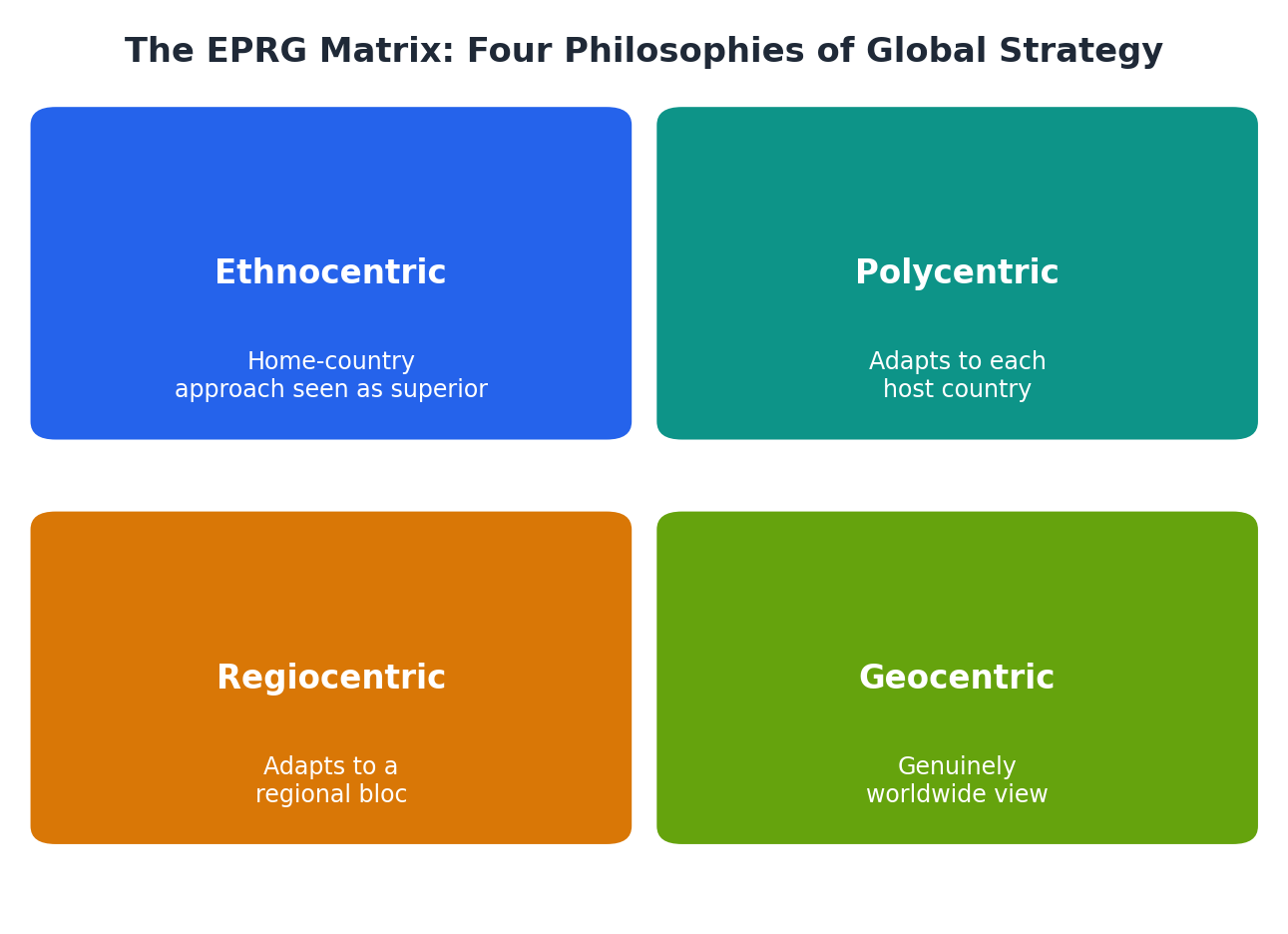
The EPRG matrix: four philosophies of global strategy
Each of these philosophies has real implications for the strategy a business is likely to pursue. Part of a manager’s job is identifying which philosophy the organization actually operates under today — which isn’t always the one leadership assumes — and how far it needs to shift to support the global strategy the business actually wants.
That strategy, in turn, needs a genuinely global vision behind it: treating the entire world as a potential market, viewing competition as a worldwide phenomenon, and structuring operations, culture and decision-making to operate at a global scale rather than as a series of disconnected local efforts.
Frequently Asked Questions
-
What are the four levels of culture in global business?
National, business, industry and organizational culture — each shapes and is shaped by the others, and all four matter for how a global business actually operates in a given market.
-
What is the EPRG matrix?
A framework for classifying an organization’s underlying philosophy toward global business into one of four types: ethnocentric (home-country focused), polycentric (host-country focused), regiocentric (regional focus) or geocentric (genuinely worldwide).
-
Why does culture matter for management, not just marketing?
Because it shapes employee attitudes toward time, hierarchy, motivation, loyalty and initiative — all of which directly affect how a global organization needs to be managed, not just how its products are marketed.
-
Can cultural diversity be an advantage rather than a challenge?
Yes — managed well, cultural diversity is a genuine source of the innovative thinking businesses need to stay competitive in a changing environment. Managed poorly, the same diversity can become a source of internal conflict.