





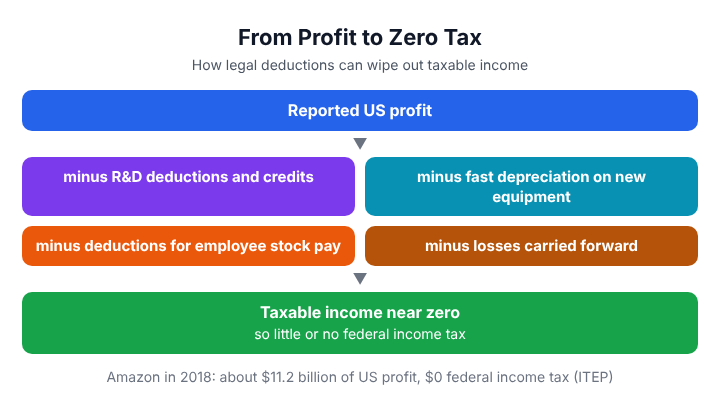
In 2018, Amazon reported about $11.2 billion of profit in the United States and paid no federal income tax at all. In fact, it reported a tax rebate. That same year, Netflix paid no federal income tax on about $856 million of US profit, according to the Institute on Taxation and Economic Policy (ITEP). The same study found dozens of other profitable US companies, across many industries, with similar results.
News like this causes understandable anger. Headlines often point out that ordinary workers paid more federal income tax than some of the world’s most valuable companies. Those headlines are not false, but they can give a misleading picture.
Amazon and Netflix were not breaking the law. Their tax bills fell to zero mainly because of tax breaks that Congress deliberately created to encourage investment, research and employee share ownership.
This article explains how profitable companies can legally pay little or no corporate income tax, how taxes shape the behavior of multinational companies, and how governments have responded.
Profit Is Not the Same as Taxable Income
Companies are taxed on their taxable income, not on the profit they report to shareholders. The two can be very different.
Accounting rules aim to show a company’s true performance over time. Tax rules, by contrast, are also used by governments to encourage certain behavior. When the tax rules let a company deduct certain costs faster or more generously than accounting rules do, taxable income can fall far below reported profit, sometimes to zero.
The Main Tax Breaks Used by Amazon and Netflix
-
Research and Development Deductions
Technology companies spend huge sums on research and development (R&D), which builds intellectual assets that pay off for many years.
For most of the period when Amazon paid no tax, US law allowed companies to deduct their R&D spending in full in the year it was spent, rather than spreading it over several years. Companies can also claim a separate research tax credit. Together, these breaks greatly reduce taxable income for companies that spend heavily on research.
The rules have changed back and forth. From 2022, companies had to spread domestic R&D costs over five years. The federal tax legislation enacted in July 2025 (widely known as the One Big Beautiful Bill Act) restored the immediate deduction for domestic research costs, under a new Section 174A of the tax code, for tax years beginning after December 31, 2024. Research carried out abroad must still be spread over 15 years. Supporters argue that generous R&D breaks help keep the United States a world leader in innovation.
-
Faster Depreciation on New Investment
Normally, the cost of buildings and equipment is deducted gradually over their useful life. US law has at times allowed companies to deduct most or all of the cost of new equipment immediately, a rule known as bonus depreciation. The 2017 tax reform allowed a full immediate deduction from 2017, but scheduled it to phase down by 20 percentage points a year from 2023 (to 80% in 2023 and 60% in 2024), which held back some capital spending. The July 2025 legislation restored 100% bonus depreciation and made it permanent.
The aim is to encourage companies to invest in factories, warehouses and machinery, which create jobs and economic activity, instead of using spare cash only to buy back their own shares. Fast-growing companies such as Amazon, which was building warehouses and data centers at a huge pace, benefit greatly.
-
Deductions for Stock-Based Pay
Many tech companies pay employees partly in shares. For tax purposes, a company can deduct the value of these shares when employees receive them. If the share price has risen sharply, the tax deduction can be much larger than the cost shown in the company’s accounts. For a company with a soaring share price, like Amazon in those years, this deduction was worth billions.
-
Losses Carried Forward
Amazon spent many years making little or no profit as it invested in growth. Tax rules let companies carry losses forward and use them to reduce taxable profits in later years. Past losses and unused credits can wipe out tax on current profits.
As these benefits were used up and profits grew, Amazon’s US tax payments rose substantially in later years.
Tax break What it allows Why the government offers it R&D expensing and credit Deduct research costs immediately, plus a credit To encourage innovation Bonus depreciation Deduct the cost of new equipment immediately To encourage investment and jobs Stock compensation deduction Deduct the value of shares given to employees To treat stock pay like cash pay Loss carryforwards Offset past losses against future profits To avoid taxing companies that lose money over time
The Rules Today: A Quick Checklist
The four breaks above still exist in US tax law, but with important limits. A company relying on them should check:
- Domestic vs. foreign research: Domestic research costs can now be deducted immediately, while research performed abroad must be spread over 15 years. Keep the two separate in the accounts.
- Loss carryforwards: Losses from tax years before 2018 can be carried forward for 20 years and can offset all of a year’s taxable income. Losses from 2018 onward can be carried forward indefinitely but can offset only up to 80% of taxable income in any year.
- Stock-based pay: The deduction equals the value employees receive when their shares vest or options are exercised, which can be higher or lower than the expense shown in the accounts.
- The minimum tax floor: Companies with average annual financial statement income above $1 billion must also check the 15% Corporate Alternative Minimum Tax, which can limit how far these breaks reduce their tax bill.
How Taxes Shape Corporate Behavior
Corporate tax is a major cost for multinational companies, so they are very sensitive to changes in tax rules. Several patterns stand out.
Tax Competition
Before globalization, companies had few options other than to operate in their home country. Today, they can choose where to locate factories, offices and headquarters, and governments compete to attract them.
Amazon’s search for a second headquarters in 2017 and 2018 is a famous example: hundreds of US and Canadian cities and regions submitted bids, many offering tax incentives. The same competition happens between countries, and critics call it a “race to the bottom” in tax rates.
Mobile Assets and Profit Shifting
Some of the most valuable assets of modern companies, such as patents, software, brands and data, are intangible and easy to move. Companies have often placed these assets in subsidiaries in low-tax countries. Other parts of the group then pay those subsidiaries royalties for using them, shifting profits from high-tax countries to low-tax ones.
The OECD has estimated that profit shifting of this kind costs governments around the world between 100 and $240 billion a year.
Tax Rates and the Location of Jobs
High corporate taxes can encourage companies to move operations abroad. When they do, the home country loses not only corporate tax, but also income and payroll taxes on the jobs that move with them. This is one reason governments are cautious about raising corporate tax rates.
How American Companies Cut Their Taxes Before 2018
Before 2018, the US combined one of the highest corporate tax rates among rich countries, 35% at the federal level, with a system that taxed US companies on their worldwide profits. Foreign profits were taxed only when brought home, so companies developed several strategies:
- Moving headquarters abroad (inversions): Some companies merged with foreign firms and moved their legal home to lower-tax countries. Burger King’s 2014 merger with Canada’s Tim Hortons is a well-known example.
- Keeping profits abroad: Because tax was due only when profits were brought back to the US, companies left trillions of dollars in foreign subsidiaries, sometimes waiting for a lower tax rate or a tax holiday.
- Blending foreign income: The US gave credit for taxes paid abroad. Companies mixed profits from high-tax and low-tax countries so that the average foreign tax was close to the US rate, leaving little extra US tax to pay.
- Borrowing from their own subsidiaries: A US parent could borrow from a foreign subsidiary and deduct the interest in the US, shifting profit to the lower-tax country. This is known as earnings stripping.
- Concentrating R&D in the US: Companies took generous US deductions for research, while the resulting intellectual property earned profits in subsidiaries around the world.
The Tax Cuts and Jobs Act of 2017 changed many of these incentives. It cut the federal corporate rate to 21%, largely ended the deferral of tax on foreign profits, imposed a one-time tax on profits held abroad, and added new rules to discourage profit shifting.
| Strategy | How it worked before 2018 | What changed |
|---|---|---|
| Inversions | Move the legal headquarters abroad | Earlier rules and a lower US rate made it less attractive |
| Keeping profits abroad | Defer US tax until profits came home | One-time tax on past profits; deferral largely ended |
| Blending foreign income | Average high- and low-tax profits to limit US tax | New minimum tax on certain foreign profits |
| Intercompany loans | Deduct interest paid to foreign subsidiaries | Tighter limits on interest deductions |
The Global Response
Individual countries find it hard to stop profit shifting on their own, because multinational companies have so many options. So governments have started to cooperate.
Under an agreement led by the OECD, many countries have introduced a global minimum tax of 15% on the profits of large multinational groups. If a company pays less than 15% in one country, other countries can collect the difference. The European Union has also proposed common rules for calculating the profits of large companies operating across its member states.
Is This Fair?
There are strong arguments on both sides.
Critics of zero-tax outcomes argue that:
- Ordinary taxpayers end up bearing a larger share of the cost of government.
- Tax breaks mostly benefit large firms that can afford expert advice.
- Smaller competitors that cannot use the same breaks are put at a disadvantage.
Supporters of the tax breaks argue that:
- Lawmakers designed them deliberately to encourage research, investment and job creation.
- Companies like Amazon generate large amounts of other taxes, such as payroll and sales taxes, through their warehouses, data centers and workforce.
- If the outcome is unfair, the answer is to change the law, not to blame companies for following it.
Conclusion
Amazon, Netflix and other profitable companies paid no US federal income tax in some years mainly because of legal tax breaks for research, investment, stock-based pay and past losses. Multinational companies have also used the mobility of their intangible assets to shift profits to low-tax countries, and before 2018, US companies used a range of strategies to reduce their taxes on foreign profits.
Governments have responded with tax reform at home and a global minimum tax abroad. The debate continues over how to encourage investment and innovation while making sure that the most profitable companies pay a fair share.
Frequently Asked Questions
How did Amazon pay no federal income tax?
In 2017 and 2018, Amazon used legal tax breaks, mainly deductions for research and development, fast depreciation on new investment, deductions for stock-based pay to employees, and losses carried forward from earlier years. These reduced its taxable income to zero.
Is it legal for companies to pay zero tax?
Yes, when they use deductions and credits allowed by law. Tax avoidance using legal breaks is different from tax evasion, which is illegal.
What is profit shifting?
Profit shifting is when multinational companies move profits from high-tax countries to low-tax countries, often by placing intellectual property in low-tax subsidiaries and charging royalties to the rest of the group.
What is a corporate inversion?
An inversion is when a company moves its legal headquarters to another country, usually by merging with a foreign company, to reduce its taxes.
What is the global minimum tax?
It is an OECD-led agreement under which many countries apply a minimum 15% tax rate to the profits of large multinational groups, so that shifting profits to low-tax countries brings less benefit.